Sunday, October 28, 2012

Hurricane Donna (1960)


Hurricane Donna made landfall in North Carolina, then reemerged into the Atlantic, before making a second landfall in eastern Long Island. This storm produced a record-breaking 11-foot storm tide at Battery Park in New York City (http://www.nyc.gov/html/oem/html/hazards/storms_hurricanehistory.shtml.) Note that Donna, like the 1944 storm, produced a higher storm tide to the left of its track, near New York City, than it did on the "strong side" of the storm.

This is the third of five maps depicting storm surge/ storm tide history for storms that impacted the New York City area.

The 1944 Hurricane


The 1944 Hurricane produced terrific wind damage in Southeastern New England, and dangerous storm surge from New Jersey to Cape Cod. It is interesting to note that the highest water levels occurred to the west of the storm track, in coastal New Jersey. Such observations may provide evidence regarding the vulnerability of northeastern New Jersey and the New York City area to surge. The coast bends at a sharp angle near New York City, which can trap water and elevate surge levels in this area.

This is the second of five maps depicting historic storms that generated storm surge that affected the New York City area.

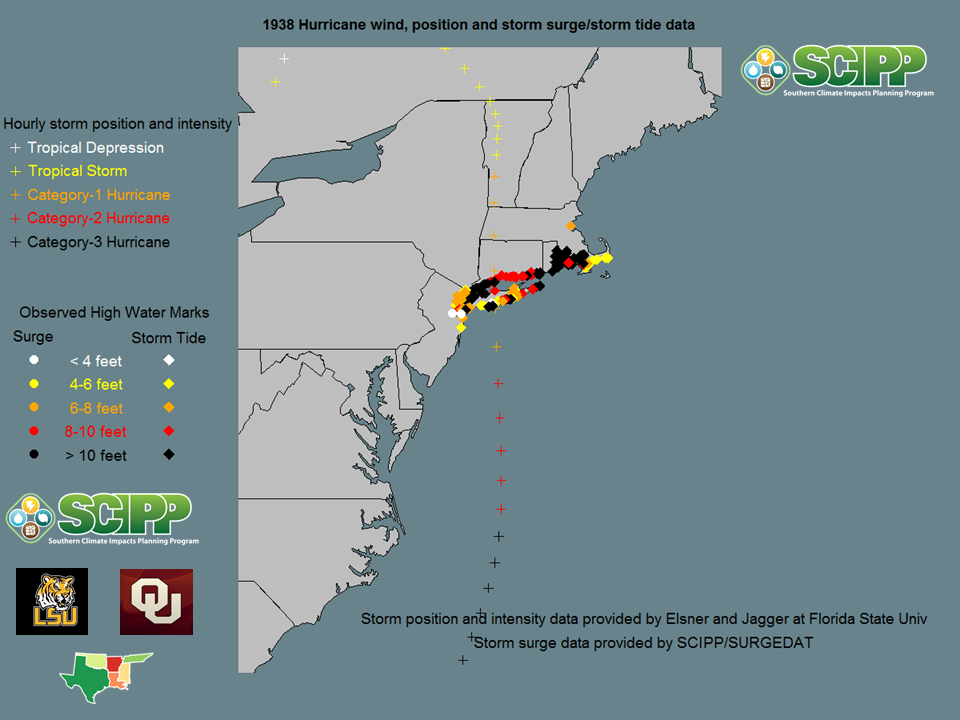
The 1938 Hurricane


The 1938 Hurricane produced a massive surge and storm tide that exceeded 10 feet from near New York City east to near New Bedford, Massachusetts. Although the storm made landfall as a category-1 hurricane, it packed category-3 winds less than 12 hours before landfall on Long Island.

This is the first of five maps depicting historic storms that generated storm surge that affected the New York City area.

Sandy likely to slam Mid-Atlantic Coast

Sandy is forecast to slam the Mid-Atlantic Coast early this week. Although the storm will likely make landfall early Tuesday morning, wind and surge impacts will likely begin to worsen on Monday. This image from the GFS model forecasts Sandy to be wound up with a steep pressure gradient, centered off the Delaware or New Jersey Coast on Monday afternoon.

Source: http://moe.met.fsu.edu/cgi-bin/gfstc2.cgi?time=2012102818&field=Sea+Level+Pressure&hour=Animation

Friday, October 26, 2012

Sandy May Be A Dandy


All eyes are on Hurricane Sandy as she moves north in the northern Bahamas this morning. (See image from NHC above.) Sandy is forecast to track north, then northeast, and then do something rather unprecedented- turn back towards the northwest and make landfall somewhere in the Mid-Atlantic Coast.

Given the current forecast, Sandy could generate a devastating storm surge in the Mid-Atlantic States, New York City area, Long Island, and the southern coast of New England.

It is unusual for storms to curve back to the northwest or west once they track from south to north and pass the Carolinas.

This unusual path may be a worst-case track for some areas, at least for storm surge generation. Given the current forecast, coastal New Jersey and New York would be on the strong side of the storm with strong onshore winds. Typically, hurricanes curve to the northeast, keeping these areas on the weak side of the storm.

It is important that coastal interests do not look too much at the storm category and compare Sandy to storms like Irene (2011) or Gloria (1985). These storms tracked along the coast, but did not curve back to the west like the forecast for Sandy. Even if Sandy becomes a tropical storm or a sub-tropical system, under the current forecast, this event could pile up considerable water along the coast, including in the New York City area.

Stay tuned to the National Hurricane Center, National Weather Service and local media for updates. SCIPP is not involved at this time with surge models for this area, but other universities and agencies may produce interesting surge models/ forecasts, particularly because this event could be potentially catastrophic for this highly populated coastline.

Saturday, September 1, 2012

Hurricane Isaac Preliminary Maximum Storm Surge Levels

I've comprised a list of preliminary Hurricane Isaac maximum storm surge levels, taken from NOAA Tides and Currents (National Ocean Service), USGS tide gauges, and at least one anecdotal source. This list will probably grow as more data become available. Later this fall or this winter, the list will become official, as verified surge data and published reports become available.

Rank Level_ft   Station Name State Agency/ Source Datum
1   13.6   Lake Borgne Surge Barrier LA nola.com NAT
2   11.02   Shell Beach LA NOS NAT
3   10.9   Little Irish Bayou at I-10 LA USGS NAVD88
4   8   Bayou Laloutre at Ycloskey LA USGS NAVD88
4   8   Bay Waveland Yacht Club MS NOS NAT
6   7   Pass Manchac LA USGS NAVD88
7   6.2   New Canal Station LA NOS NAT
8   6.1   Liberty Bayou at Hwy 433 LA USGS NAVD88
9   4.6   Coast Guard Sector Mobile AL NOS NAT
10   4.4   Pascagoula NOAA Lab MS NOS NAT
11   4.3   Chickasaw Creek AL NOS NAT
12   4.2   Grand Isle LA NOS NAT
13   4   Mobile Bay at Hwy 193 AL USGS NAVD88
13   4   Pilots Station East, SW Pass LA NOS NAT
15   3.55   Dauphin Island AL NOS NAT
16   3.5   Pensacola FL NOS NAT
17   2.5   Panama City FL NOS NAT
18   2.2   Lawma, Amerada Pass LA NOS NAT
 

Note: NOAA Tide and Currents (NOS) data are storm surge levels, or height above normal astronomical tide. USGS data are storm tide levels, measured above NAVD88 level. All data are preliminary.

How do these data fit into the larger context of storm surge history along the U.S. Gulf Coast? Are any of these surge levels unprecedented for a category-1 hurricane? How do these water levels compare to other surges in a specific location?

Although it's impossible to answer all of these questions on the surge blog, if you have specific questions like these, please contact "Hurricane" Hal Needham at hneedh1@lsu.edu. Hal maintains SURGEDAT, the world's most comprehensive storm surge database. SURGEDAT has currently archived more than 6,000 coastal high water marks produced by hurricanes and tropical storms along the U.S. Gulf Coast and U.S. Atlantic Coast. SURGEDAT also contains data for more than 250 peak surge events that have occurred internationally since 1880.
 

Lake Pontchartrain remains elevated, likely enhanced rainfall flooding

Lake Pontchartrain remains elevated today, more than three days since Hurricane Isaac made landfall in southeast Louisiana. Although the lake level has slowly been falling since early Thursday, the level was still about three feet above normal earlier this morning, according to the NOAA Tides and Currents gauge at New Canal Station on Lake Pontchartain. The water level at this location was at least four feet above normal for approximately 60 hours, beginning at around 10PM on Aug 28th until around 10AM on Aug 31st.

According to preliminary levels provided by NOAA Tides and Currents, the maximum level at New Canal Station was around 6.2 feet above normal. A USGS site at Pass Manchac, between Lake Pontchartrain and Lake Maurepas, reported a preliminary level of around 7 feet.

The prolonged storm surge event in Lake Pontchartain may have contributed to enhanced flooding from heavy rainfall around the lake. Flooding occurred in several communities near the lake, including Laplace, Mandeville and Slidell. It's likely that heavy rainfall could not drain as quickly as normal due to the storm surge inundation at the lake.

A similar situation happened in June near Tampa, Florida, when heavy rainfall runoff from Tropical Storm Debby was impeded by elevated water levels in Tampa Bay due to storm surge. Also, respondents to the Gulf Coast Climate Information Needs Assessment survey in the Houston/ Galveston area noted that heavy rainfall runs off slower when the level of Galveston Bay is elevated. (link: http://www.southernclimate.org/publications/Gulf_Coast_Assessment_Final.pdf). It appears that this pattern is widespread and most likely applies to some of the flooding caused by Hurricane Isaac in Louisiana.